Game Structure
Quick Reference
- Game length: 4 Rounds by default (set by Round Tracker Tokens; varies by Objective)
- Round start: Player holding the Initiative Token takes the first Turn
- Turns alternate between players until one Passes or all models are Exhausted
- Passing: A player who Passes takes no more Turns that Round; opponent may continue activating
- Retreating: Declare when Passing — flip Initiative Token to Retreat side; all your models removed at end of Round, game ends immediately
- Active model actions per Turn: one or more; each Action requires Taking Fatigue
- Unengaged actions: Get Moving, Open Fire, Patch Up, Rummage
- Engaged actions: Back Off, Brawl
- Each specific Action may only be taken once per Turn per model (unless a rule overrides this)
- Timing ties: resolved in order chosen by the player holding the Initiative Token
- Crew composition: up to 5 Grunts per Champion; crew Tier affects Champion Limit, Upgrade Limit, Facility Limit
- Friendly = same crew; Enemy = different crew
Playing the Game Flow
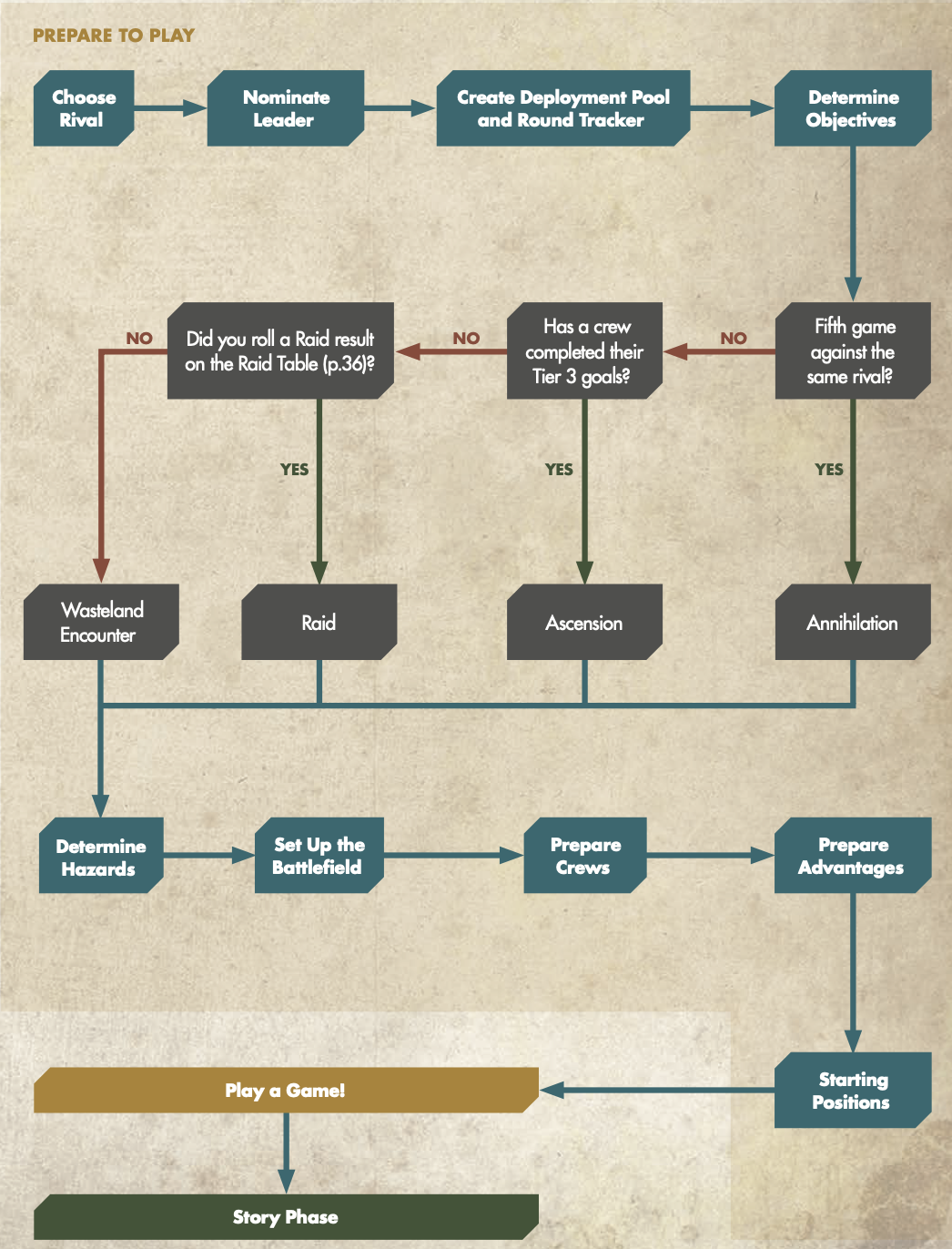
The diagram below shows the flow of a game of Fallout: Factions from start to finish; beginning with Preparing to Play (pg. 34), then Playing a Game, and ending with the Story Phase (pg. 52). This chapter explains the core rules for playing Fallout: Factions, though it doesn't cover choosing Objectives, or setting up and running a Campaign — these topics will be covered in later chapters. [Rulebook pg. 9]
The Crew Roster
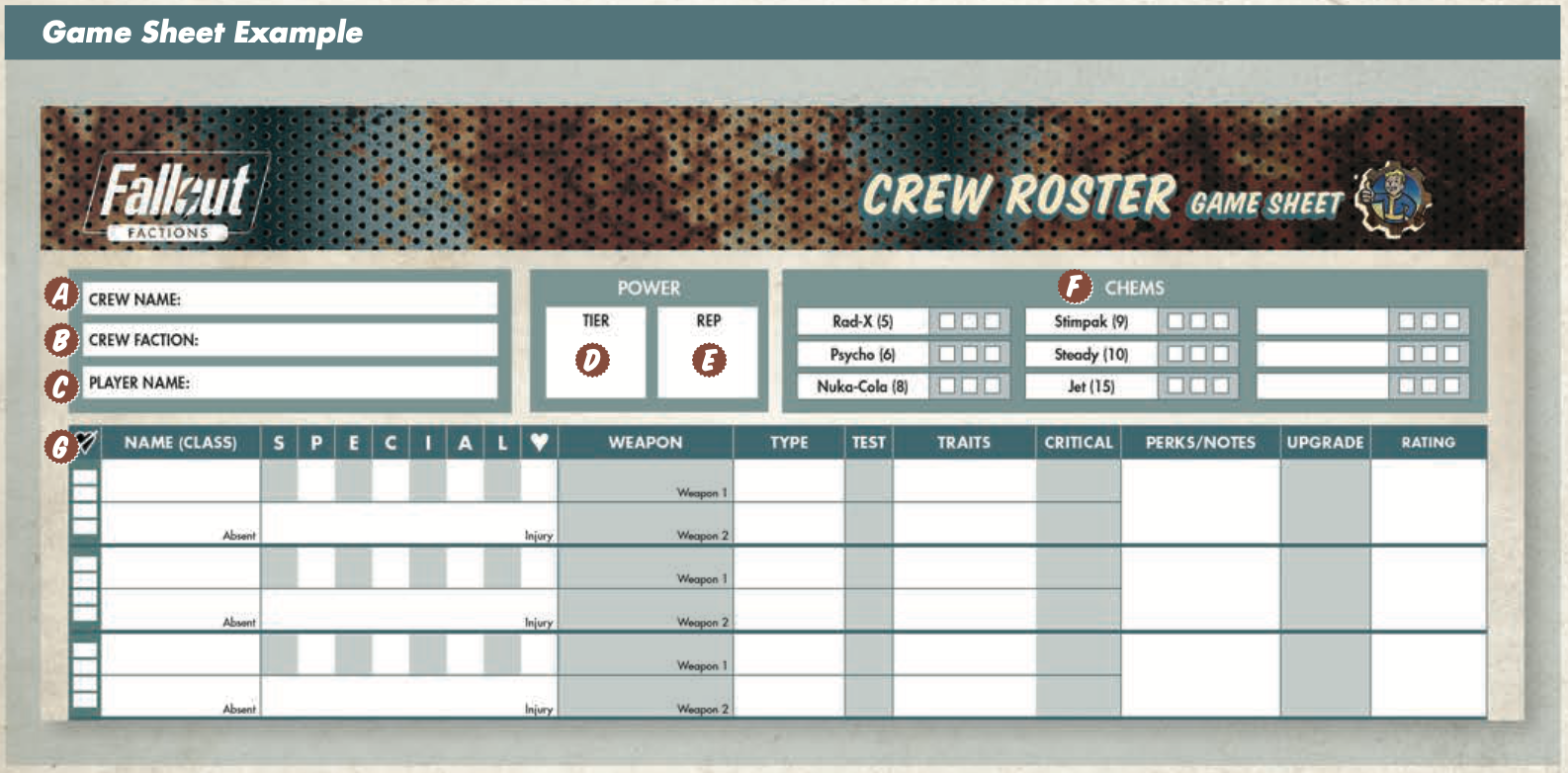
Each player has a Crew Roster, which is made up of two sheets. [Rulebook pg. 12]
The Game Sheet acts as a quick reference during play and records all the information about the models in a player's crew.
The Story Sheet tracks the crew's progress between games.
Both sheets have the following elements:
- Crew Name: The name of a player's crew, filled in when they create their crew.
- Crew Faction: The Faction that a crew belongs to. A Faction is chosen when making a crew from any of the available Factions in this book, or additional Fallout: Factions content.
- Player Name: The player's name.
Game Sheet
The Game Sheet is made up of the following elements: [Rulebook pg. 12]
- Tier: Crews all start at Tier 1, and can rise to Tier 3 during a campaign. A crew's Tier affects the Limits of their models' Upgrades, Champions, and how many Facilities they can build.
- Reputation (REP): The combined Rating of all a crew's models, updated between each game.
- Chems: The tracker that marks how many Common and Rare Chems a crew has.
- Model Entries: The main body of the Game Sheet contains a list of Model Entries. Each row is an Entry for a single model, listing all of the information that will be needed to use that model during a game.
Story Sheet
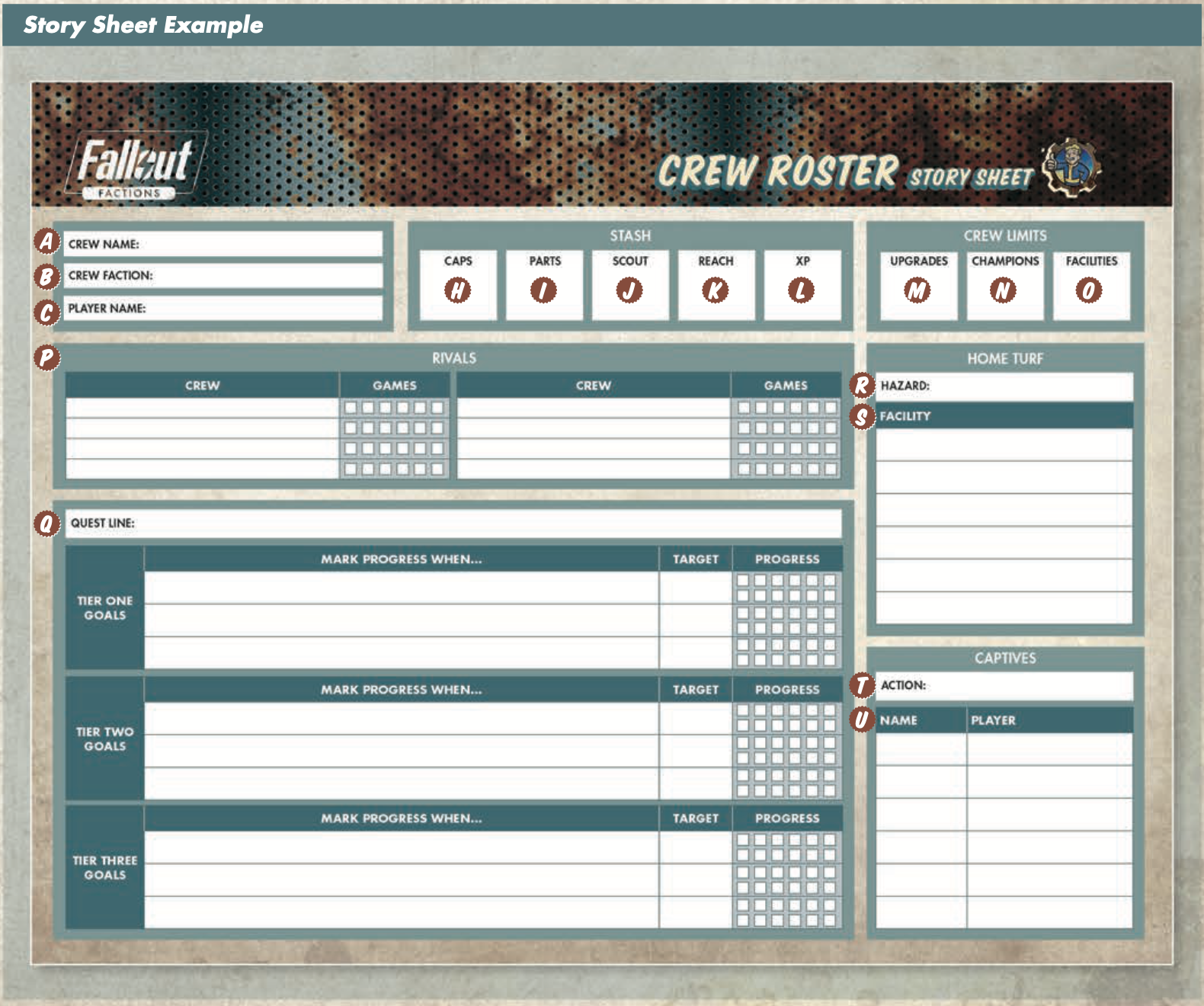
Most games of Fallout: Factions are linked in a Campaign, and during a campaign, players use their Story Sheet to track all the information they need between games, including: [Rulebook pg. 12–13]
- Caps: The number of Caps available to the crew. Caps are mostly used to recruit new models.
- Parts: The number of Parts available to the crew. Parts are mostly used to modify weapons.
- Scout: The number of Scouting Points available to the crew. Scouting Points have a range of uses, usually letting a player roll more dice during Story Actions and exert influence over the game setup.
- Reach: The Reach of the crew. Reach is used to build Facilities, complete Quests, and exert power.
- XP: The experience the crew has accumulated. XP is used to Upgrade models, which improves their S.P.E.C.I.A.L. statistics and grants Perks.
- Upgrade Limit: This is the maximum number of Upgrades each model in the crew can have, restricting how powerful any single model can become. This Limit is raised when the crew reaches new Tiers.
- Champion Limit: This is the maximum number of Champions the crew can have. Since a crew can usually only have 5 Grunts per Champion, this also functions as an upper restriction on the total number of models in a crew.
- Facility Limit: This is the maximum number of Facilities the crew can have on their Home Turf. Facilities give powerful out-of-combat Abilities and Actions to the crew.
- Rivals: Players use this section to keep track of their games and how many times they have fought other players during the campaign.
- Quest Line: At the end of the first game, this box is filled with a crew's Quests and Goals. These are completed over the course of a campaign. Once all are filled in, a crew earns a chance to Ascend into Legend!
- Home Turf Hazard: An interesting Battlefield aspect of a crew's Home Turf, such as a Minefield or Urban Ruins. If this box is empty, the crew is considered Nomadic, still searching for a place to settle.
- Home Turf Facility: The Facilities available on the crew's Home Turf. These improve Story Actions and can be lost if an opposing player raids their Home Turf.
- Captive Story Action: The Factions use different methods to deal with the models they capture from other players' crews. A crew's available Captive Story Action is recorded here.
- Captives: When your crew takes a Captive in battle, they are recorded here.
Crews and Models
During a game, each player controls a crew made up of models. [Rulebook pg. 14]
Each model in a crew comes from the same Faction (such as the Brotherhood of Steel, Super Mutants, Survivors, or Wasteland Raiders). All of the rules for a Faction and its models are gathered together in Faction Lists in the Appendix.
When the rules refer to a Friendly model, this means any model from the same crew as the model in question. Similarly, any reference to an Enemy model refers to a model from a different crew, even if they're members of the same Faction.
Model Classes
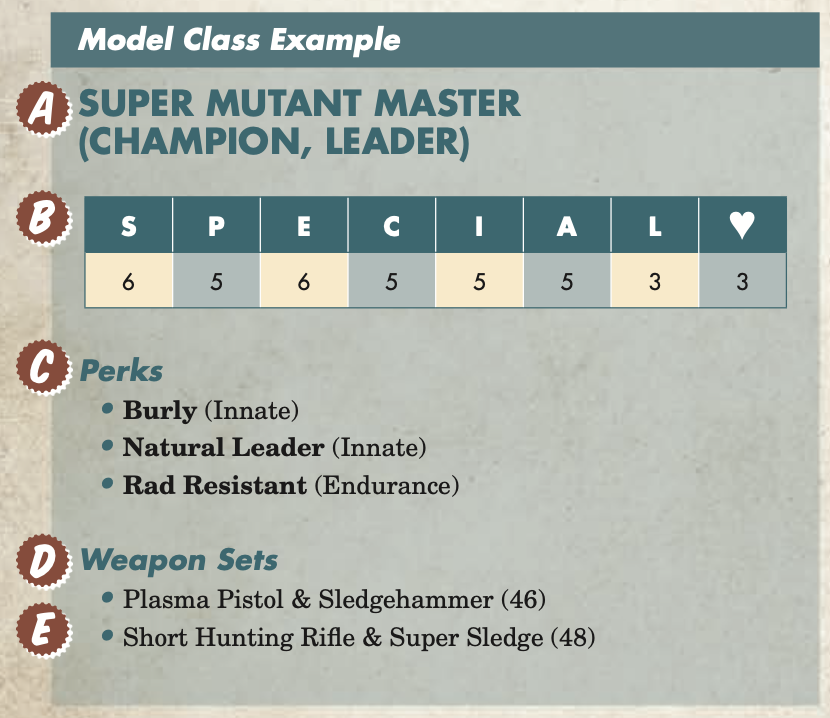
When choosing models for their crew, a player consults the Model Classes section of their Faction List. This section shows the different types of models that are available to that Faction. [Rulebook pg. 14]
Each Class shows:
- Its name and whether it is a Champion or a Grunt
- Its S.P.E.C.I.A.L. Profile
- Any Perks the model begins with
- Available Weapon Sets, chosen when adding the model to your crew
- The Rating value of the model (dependent on the Weapon Set it is equipped with)
Champions and Grunts
Each Class is either a Champion or a Grunt. [Rulebook pg. 14]
Champions form the crew's experienced core. They are often good all-round fighters and can be relied upon to get their job done, but there are only a few of them in each crew.
The rest of the crew is made up of Grunts, who are less effective one-on-one but make up for this with greater numbers. They are often best used to support a Champion's Actions.
S.P.E.C.I.A.L. Profile
Each Class has its own S.P.E.C.I.A.L. Profile. This is a set of seven statistics, each of which has a numerical value — the higher the value, the more proficient the model is in that area. [Rulebook pg. 14]
| Stat | Name | Primary Use |
|---|---|---|
| S | Strength | Attacks with Melee and Heavy weapons |
| P | Perception | Firing Rifles; some Objective special rules |
| E | Endurance | Resisting attacks — used when the model is the Target to see whether it is Harmed |
| C | Charisma | Determining which allies can support a model's Actions |
| I | Intelligence | Determining whether a model follows the plan or flees when the shooting starts |
| A | Agility | Attacking with Pistols and Grenades; climbing up and down Terrain |
| L | Luck | Increases chances of success for every S.P.E.C.I.A.L. Test |
In addition to these seven statistics, each Class also has a Health value (usually between 1 and 3), which shows how many Injuries it can sustain during a game before being removed from play. [Rulebook pg. 14]
For the full dice-rolling rules for S.P.E.C.I.A.L. Tests, see S.P.E.C.I.A.L. and Dice.
Designer's Note
A model's statistics are rated from 1 to 9, with a higher number representing more proficiency. For the first six statistics (Strength to Agility), a value of 4 should be considered roughly average for a standard human character. A model with Perception 3 isn't a great shot with a Rifle while a model with Agility 6 is incredibly well-coordinated. Luck is a little different and has an average value of 2. Good fortune is hard to come by in the Wasteland! [Rulebook pg. 15]
Game Structure
Most games of Fallout: Factions take place over four Rounds. In each Round, players will take Turns activating models to make Actions, move around the Battlefield, and make attacks. [Rulebook pg. 23]
Rounds
Each Round consists of a series of Turns that alternate back and forth between players. The player with the Initiative Token takes the first Turn in the Round, followed by their opponent, and so on. [Rulebook pg. 23]
When they become the Active Player, a player may decide to Pass instead of taking their Turn. They might have run out of things to do, or it may suit their strategy to stop early. Once a player has Passed, they don't take any more Turns during the Round; instead, the other player takes any number of Turns, one after the other until they cannot activate any more of their models, and then the Round ends.
At the start of each game, an average of four Round Tracker Tokens are placed next to the Battlefield, but more or less may be added according to the Objective being played. At the end of each Round, the lowest-numbered Token is flipped face-down. If there are no face-up Tokens left, the game ends and it is time to move onto the Story Phase (see pg. 52).
Timing
Some rules are resolved "at the start of a Round" or "at the end of a Round." [Rulebook pg. 23]
Rules that are resolved at the start of a Round happen immediately before the crew with the Initiative Token takes their first Turn. Rules that are resolved at the end of a Round happen immediately after the player who did not Pass finishes their final Turn (but before the Round Tracker Token is flipped).
If more than one rule takes effect at the same time, they are resolved in an order chosen by the player who currently holds the Initiative Token.
Taking a Turn
During a player's turn, they are referred to as the Active Player. [Rulebook pg. 23]
At the start of the Turn, the Active Player picks one of their models that is not Exhausted; this becomes the Active Model until the end of the Turn.
The Active Player makes one or more Actions with the Active Model, as described below. Once they either do not wish to make any more Actions, or cannot make any more Actions (due to the Active Model being Exhausted or a similar effect), the Turn ends and the other player begins their Turn. This continues until the Round ends.
Passing
After their Turn starts, but before they choose an Active Model, the Active Player may declare they will Pass. [Rulebook pg. 23]
The other player may then continue to take Turns, remaining the Active Player until they either no longer wish to take any more, or cannot (if all of their models are Exhausted, for example). At that point, the Round ends, and the Round Tracker Tokens are checked and adjusted.
Errata
The first player to Pass takes the Initiative Token (or keeps it if they already have it). Note that this does not count as the second player Passing, so they do not take the Initiative Token. [Errata Q2 2026]
Actions
During a Turn, the Active Model can make one or more Actions. When a model takes an Action, it must Take Fatigue. [Rulebook pg. 23]
There are a number of different Actions available, each letting a model do something different. The Actions available to a model depend on whether or not it is Engaged.
During a Turn, each model in a crew may only be selected to make a specific Action once, unless another rule overrides this.
For example, once a model has been selected to make a Get Moving action, it cannot do so again later in the same Turn — though it could do so in a later Turn within the same Round.
FAQ
Q: A model can't make the same Action more than once each Turn, but can it make the same Action more than once in a Round, on different Turns?
A: Yes. For example, a model can make a Get Moving Action once in a Turn, then use their other Action for something else. That same model could also make one Get Moving Action, wait for another Turn, and then make a second Get Moving Action. [Errata Q2 2026]
Unengaged Models
| Action | Effect |
|---|---|
| Get Moving | The model moves, and can give other models around it orders to do the same. |
| Open Fire | The model targets a visible Enemy with a Ranged Attack. |
| Patch Up | The model takes a moment to recuperate. |
| Rummage | The model looks for helpful items at a Search Token. This Action is part of the Advanced Rules, and is detailed on p. 26. |
Engaged Models
| Action | Effect |
|---|---|
| Back Off | The model disengages from the Enemy. |
| Brawl | The model targets an Engaged Enemy with a Melee Attack. |
[Rulebook pg. 23]
Retreating
A crew should always know when it's time to hit the road — better to take a short-term loss than risk a number of deaths or Injuries. [Rulebook pg. 27]
When a player declares that they Pass, they can also declare that they will Retreat. They take the Initiative Token as normal but flip it upside down to its "Retreat" side, becoming the Retreating Player. At the end of the current Round, all of the Retreating player's models are removed from play and the game ends, even if there are still face-up Round Tracker Tokens.
If a player Retreats from a game on their Home Turf (pg. 30), their crew become Nomadic (pg. 54) during the Story Phase.
See Also
Retreat interactions with movement, Engagement, and positioning are covered in Movement.